As solar energy adoption accelerates worldwide, governments are offering strong incentives to make solar more affordable for homeowners, businesses, and utility-scale developers. However, incentive structures differ widely across regions. Here’s a quick comparison of how the U.S., India, the European Union, and major Asian countries support solar growth.
United States: Tax Credits & State Incentives
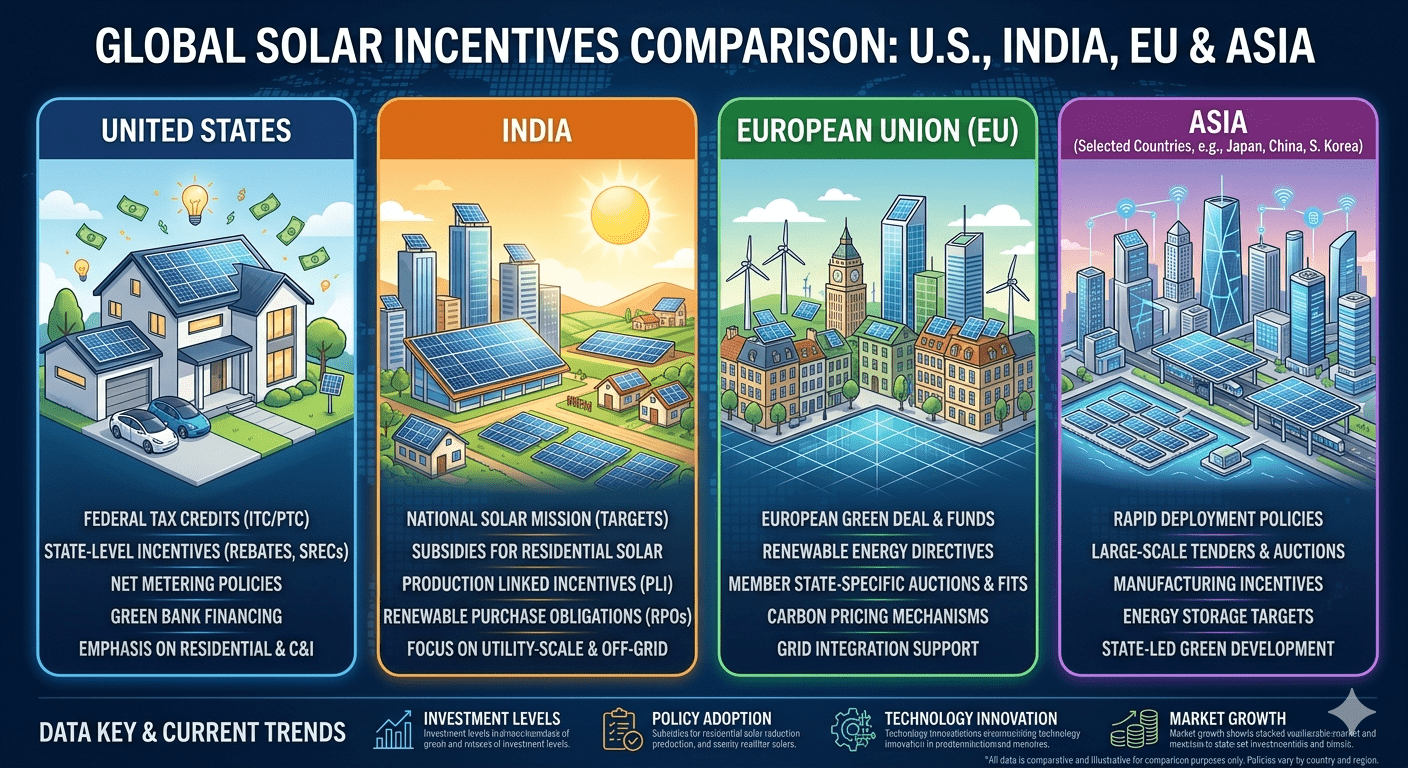
The U.S. offers one of the strongest national benefits through the Investment Tax Credit (ITC), which provides a 30% tax credit on residential and commercial solar installations. Many states add extra incentives, such as:
• Net metering programs
• State rebates (e.g., California, New York)
• Solar Renewable Energy Certificates (SRECs)
This combination significantly lowers upfront costs.
India: Direct Subsidies for Rooftop Solar
India’s focus is on making rooftop solar accessible through:
• Central subsidy under the PM Surya Ghar scheme
• State-level subsidies and incentives
• Net metering benefits
• Accelerated depreciation for businesses
Residential users get upfront financial support, making India one of the most subsidy-friendly markets for homeowners.
European Union: Grants & Feed-In Tariffs
EU countries offer a mix of incentives:
• Feed-in tariffs (Germany, France)
• Investment grants for rooftop installations
• Tax reductions and low-interest green loans
• Strong net billing policies
The EU’s energy transition goals drive substantial support for both residential and commercial projects.
Asia (China, Japan, South Korea): Policy-Driven Growth
• China: Large-scale subsidies for manufacturing, utility projects, and rural solar.
• Japan: A long-standing feed-in tariff system, although rates are gradually decreasing.
• South Korea: Cash incentives, renewable portfolio standards, and solar points for households.
These countries focus on scaling solar capacity through policy-driven programs and industry support.
Conclusion:
Global solar incentives vary by region, but the goal remains the same: to accelerate the adoption of clean energy. The U.S. leads with tax credits, India supports consumers with direct subsidies, the EU promotes long-term financial returns, and Asian countries drive growth through strong policy frameworks. For customers and businesses, understanding these incentives helps maximise savings and make smarter solar investment decisions.