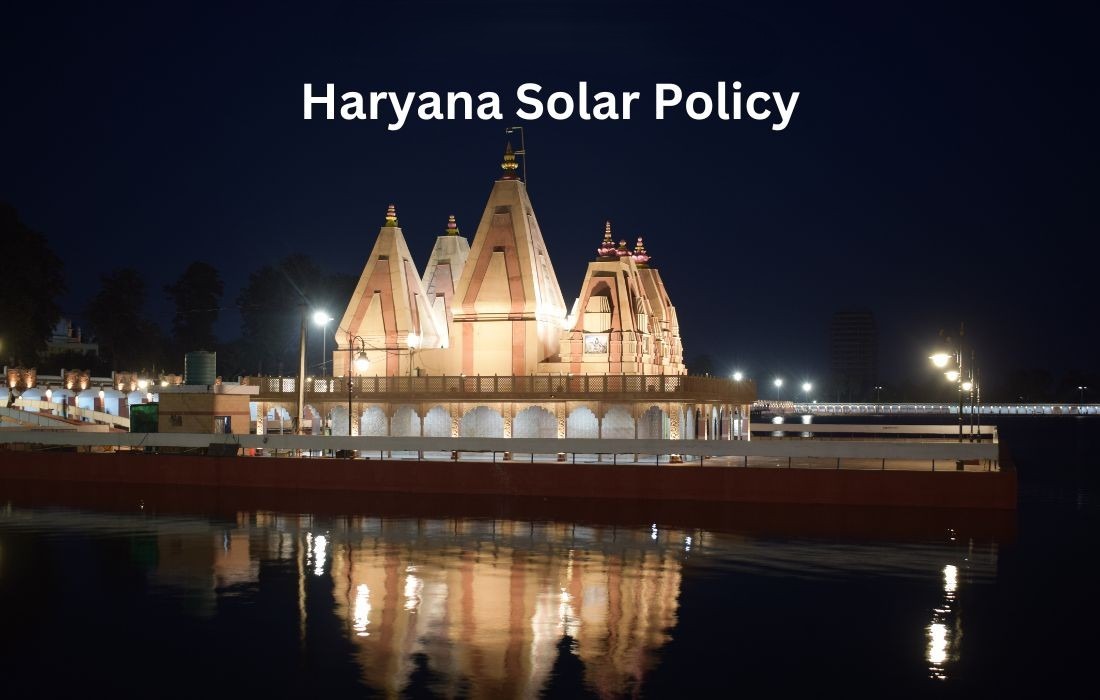
Haryana, with its strong agricultural base, growing urban centers, and good solar-insolation levels, is accelerating its move into solar energy. The state government, via the Haryana Renewable Energy Development Agency (HAREDA) and its draft and notified solar power policies, has clearly signaled a push for rooftop, utility-scale, irrigation, and hybrid solar systems.
Policy Targets & Strategic Vision:
• Haryana’s draft solar power policy aims to install 6,000 MW (6 GW) of solar capacity by 2030: comprising approximately 1,600 MW from rooftop solar, 3,200 MW from ground-mounted/utility scale, and 1,200 MW from solarisation of irrigation pumps.
• For example, a report noted: “Haryana aims to increase its solar energy capacity 22 times by 2030… the new policy focuses on rooftop installations, ground-mounted solar plants, solarisation of irrigation pumps…”
• The state is also making plans to solarise government buildings and set up model solar villages as part of its rollout.
Key Provisions & Features:
🔹 Rooftop Solar & Residential Focus
• Incentives and subsidies are offered for rooftop solar systems in Haryana. For example:
◦ Systems of 1 kW capacity may receive a subsidy of ~ ₹ 30,000.
◦ Systems of 2 kW: ~ ₹ 60,000 subsidy.
◦ For systems ≥ 3 kW, a fixed subsidy of ~ ₹ 78,000 is listed.
• The policy allows for both net-metering and gross-metering (depending on rules) and supports self-consumption of solar power.
🔹 Utility-Scale / Ground-Mounted Solar
• The policy earmarks major capacity (3,200 MW) for ground-mounted solar plants.
• It also allows leasing of panchayat land for 30-year terms and promotes solar plants on canal tops, banks, and water bodies.
• There is inclusion of newer technology, such as solar + battery storage and hybrid projects (solar plus other renewables), in the policy.
🔹 Solarisation of Irrigation and Agriculture
• The policy assigns 1,200 MW capacity for solarisation of irrigation pumps by 2030.
• Subsidy schemes for solar water pumps and other agricultural solar applications are highlighted.
🔹 Implementation & Institutional Measures
• The policy lays out ease-of-doing business features: e.g., exemption from certain charges/fees, facilitation for small systems, virtual/group metering in some contexts.
• For government buildings, the policy mandates surveys, rooftop installations, and supports CAPEX/RESCO models.
What It Means for Stakeholders:
• Homeowners & Residential Consumers: With generous subsidies (e.g., up to ₹78,000 for systems ≥ 3 kW) and high solar potential (~5+ sun hours/day in many districts) in Haryana, rooftop solar becomes a very financially viable option.
• Farmers & Agricultural Sector: Solarising pumps reduces dependence on diesel/electric grid, cuts operating cost, and can provide additional income via surplus generation. The irrigation component emphasizes this.
• Businesses, Industries & Developers: Utility-scale capacity, leasing of land/panchayat sites, and support for battery/hybrid systems open up large-scale investment opportunities in Haryana’s solar sector.
• State & Community: The push drives Haryana’s energy transition, helps meet Renewable Purchase Obligations (RPOs), enhances energy security, and supports rural and agrarian uplift via solar access and employment.
Challenges & Considerations:
• Achieving the 6 GW target by 2030 will require strong implementation — grid infrastructure, land acquisition, and timely subsidies all matter.
• For rooftop systems, careful sizing, quality vendor selection, and roof suitability (orientation, shading) remain key to realizing promised savings.
• Policy changes/regulations around banking, metering, and tariffs can impact financial outcomes — staying updated is important.
• While subsidies reduce upfront costs, maintenance, performance monitoring, and realistic generation estimates should not be overlooked.
The Road Ahead:
Haryana’s solar policy places the state firmly on India’s solar map. The combination of rooftop subsidy programs, large-scale solar targets, agricultural solarisation, and innovation (storage + hybrid) reflects a holistic approach. For anyone in Haryana — homeowner, farmer, business, investor — solar is a timely opportunity.