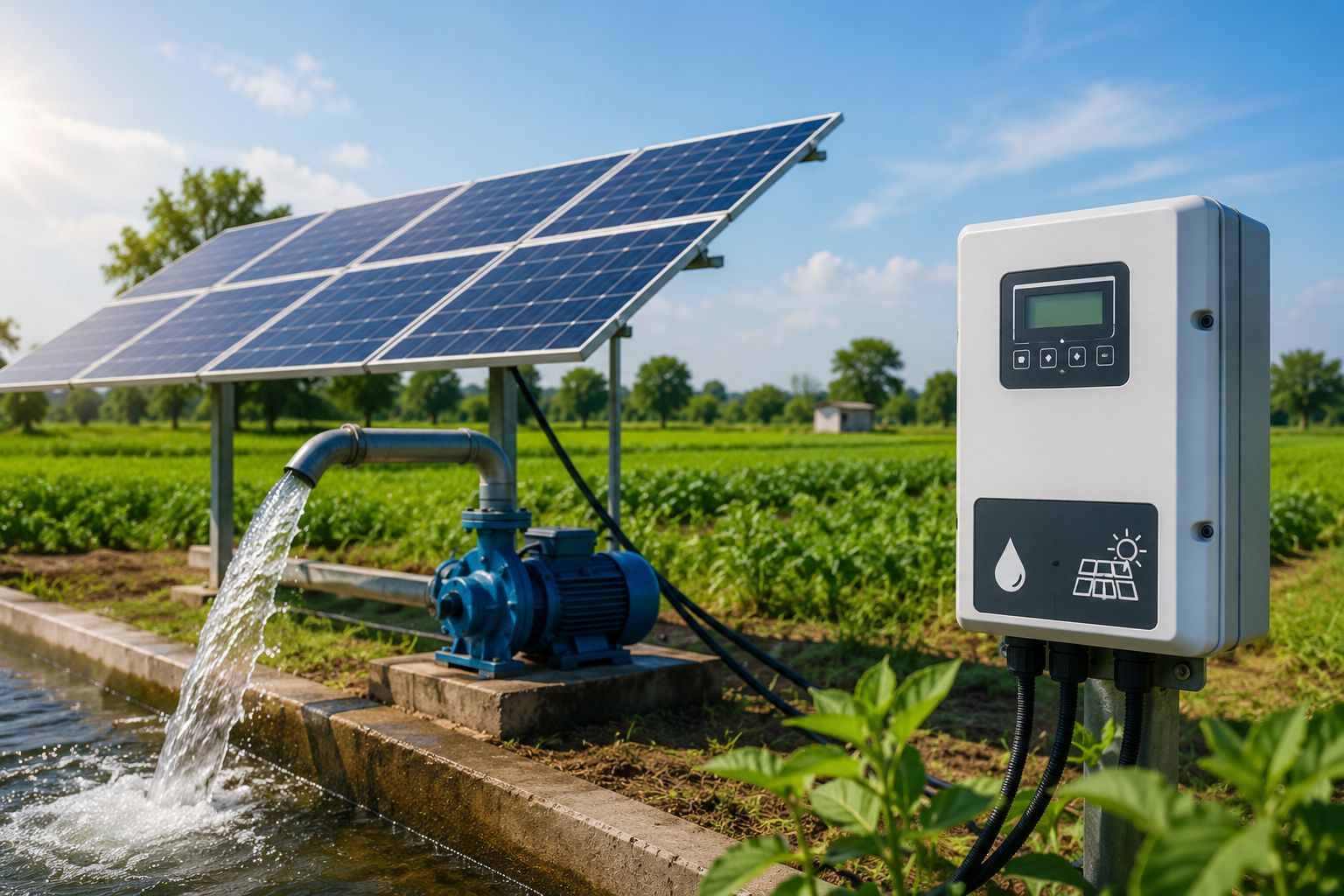
The Ministry of New and Renewable Energy (MNRE) has proposed revised technical specifications for solar photovoltaic (PV) water-pump controllers, aimed at improving their efficiency, safety, reliability and overall utilisation.
The draft, prepared by the National Institute of Solar Energy (NISE), has been released for stakeholder feedback. Comments can be submitted until August 28, 2026.
Key Proposed Changes
The draft proposes a wider operating range for solar pump controllers, allowing them to work effectively with changing PV voltage levels. Controllers rated at 10 kVA and above would also require multi-channel Maximum Power Point Tracking (MPPT) to improve solar energy harvesting and reduce losses caused by differences between PV modules.
Efficiency requirements would also become more stringent. The proposed standards include 98% minimum static MPPT efficiency and 97% dynamic MPPT efficiency, along with higher overall system-efficiency requirements depending on the controller capacity.
Solar Pumps Could Support More Than Irrigation
A major feature of the proposal is multifunctional operation. Future solar pump controllers could potentially power agricultural equipment as well as household and other farm loads.
The proposed configuration includes three-phase and single-phase outputs, with compatibility for different motor technologies such as induction, PMSM and BLDC motors.
Battery and Grid Integration
The draft also provides for integration with battery energy storage systems. Excess solar energy could be stored and used when solar generation is low or unavailable, helping improve the utilisation of solar pumping systems.
For hybrid systems, controllers could draw electricity from the grid when solar and stored energy are insufficient and export surplus solar generation when permitted under applicable regulations.
Stronger Safety and Monitoring Requirements
The proposed standards include enhanced protection and monitoring features such as:
- GSM/GPRS-based remote monitoring
- Geo-tagging
- Solar-generation tracking
- Pump operating-hour monitoring
- Water-output monitoring
- Improved dust and water protection
- Humidity and surge-protection testing
Why It Matters
The proposed revisions are intended to make India’s solar-powered agricultural pumping systems more efficient, safer and versatile. By allowing solar pump infrastructure to support additional farm and household applications, the framework could help farmers get greater value from installed solar assets while supporting India’s broader clean-energy goals.