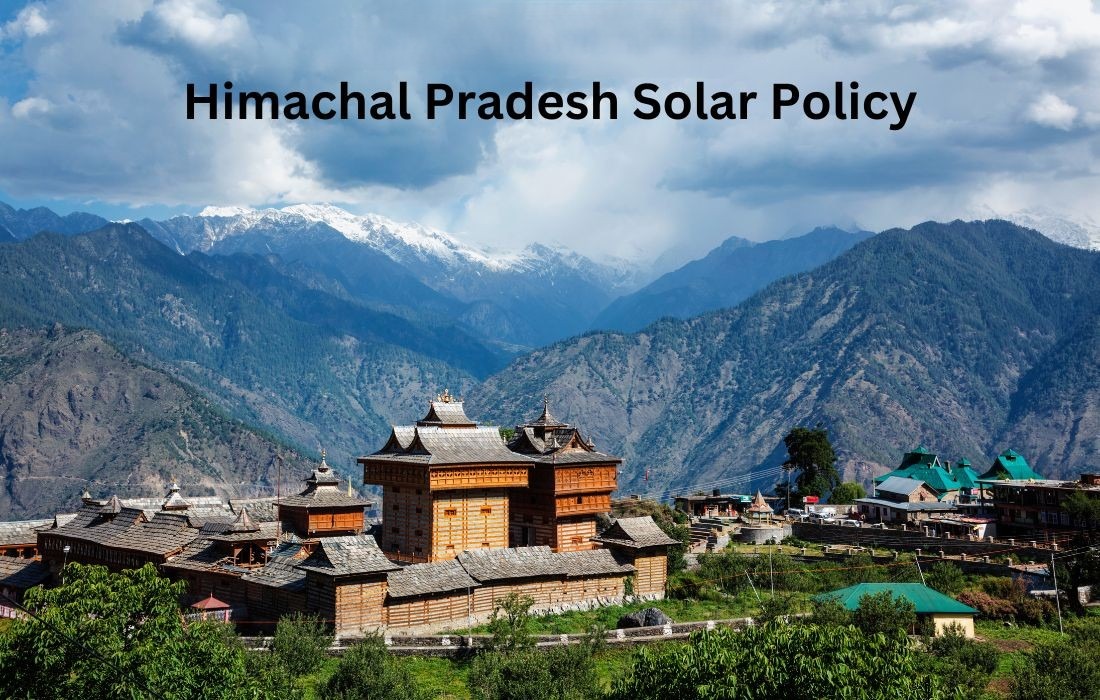
The northern Himalayan state of Himachal Pradesh is well on its path to transforming into a “green-energy” state. With abundant sunshine (especially in the lower Himalayas), available land in certain districts, and a growing appetite for clean energy, the state government has been proactively revising its solar policy framework to attract investment, accelerate deployment, and support decentralized generation.
Key Policy & Regulatory Highlights:
🔹 Nodal agency & registration process
• The state-level nodal agency for renewable/solar programs is HIMURJA (Himachal Pradesh Energy Development Agency), which is responsible for promoting renewable energy, including solar PV (both off-grid and grid-connected) in the state.
• On their website, you’ll find the investor-info page under the “Solar Projects – Investor Info” section, where applications, registration formats, process guidelines, etc., are specified.
• Some features: Solar projects can be on land owned by the developer or leased. Processing fee: ₹10,000 up to 1 MW, ₹1 lakh above 1 MW for provisional registration.
• Timeline: Projects have to be commissioned within 18-24 months (or as per PPA) once the registration/allocation is done.
🔹 Tariff Framework & PPA
• The state’s regulator, Himachal Pradesh Electricity Regulatory Commission (HPERC), periodically issues generic levellised tariffs for solar PV projects up to 5 MW capacity. For example:
◦ For FY 2024-25: ₹3.50 per kWh for up to 1 MW in non-urban areas.
◦ For FY 2025-26: Categorized as up to 1 MW, 1-3 MW, 3-5 MW; non-urban/industrial vs urban/industrial areas. Tariffs from ~₹3.45/kWh (up to 1MW non-urban) to ~₹3.38/kWh (3-5 MW non-urban) and slightly higher for urban/industrial zones.
• Tariffs exclude subsidies; if any capital subsidy is availed, the tariff may be adjusted downward.
• Model PPA: HPERC has prepared a “Model Power Purchase Agreement (PPA) for solar PV power projects (up to 5 MW)” which simplifies terms and gives a standard structure.
🔹 Incentives & Special Schemes
• The state has announced schemes for setting up solar power plants on government land in select panchayats (“Green Panchayat Scheme”) – e.g., 500 kW ground-mounted projects in 100 panchayats.
• For youth: Solar projects from 500 kW to 2 MW on own/leased land, with a subsidy of ~40% for youth in certain Gram Panchayats.
• The state removed the “first-come, first-served” condition for ground-mounted solar applications (250 kW-5 MW) to make the policy more accessible and reduce the rush.
🔹 Strategic Target & Vision
• The government has flagged that it wants Himachal to become the first “green energy state” (or among the leading ones) by 2025/26; solar is a major pillar of that vision.
• Solar + decentralized generation + local participation (panchayat involvement) are key themes. Energy access in remote/hilly areas is emphasized.
What’s New / What Improved:
• Streamlined application: The removal of “first-come, first-served” gives flexibility, reduces rush and bottlenecks.
• More clarity on scheme for youth and local panchayats: Subsidy support and revenue sharing models (for panchayats) are now defined.
• Renewed tariff orders: HPERC has updated normative capital costs, adjusted CUF (Capacity Utilization Factor) assumptions, and differentiated between urban/industrial vs rural zones.
• More transparent processes: The model PPA is publicly available; the nodal agency has investor-info pages. The state is making it easier for private participation.
What Remains Challenging (and Where Tech/Software Services Can Help):
🔹 Land, terrain & transmission constraints
Himachal’s hilly terrain poses unique challenges: finding south-facing land, dealing with slopes, and ensuring proximity to transmission/distribution infrastructure. For example, the Green Panchayat scheme details mention land criteria: “minimum 1 hectare, free from tree growth, within 500 m of an 11 kV line”.
Opportunity: GIS/remote-sensing, terrain analysis, site-selection apps, land-mapping platforms.
🔹 Monitoring & operation of solar projects
HIMURJA’s portal expects developers to provide remote monitoring access for solar plants.
Opportunity: IoT + SCADA + mobile dashboard apps for rooftop/ground-mounted solar in Himachal. Receipt of alerts, generation of data, and performance analytics.
🔹 Revenue-sharing, subsidy tracking & PPA compliance
Given the various subsidy regimes, royalty clauses (e.g., projects >1 MW may have royalty for the state), the process to track inputs, capital subsidy, PPA terms, etc, is complex.
Opportunity: CRM systems, project management tools, and subsidy-tracking modules customized for solar in Himachal.
🔹 Remote/rural deployment & community involvement
With a focus on panchayats, youth-led projects, and decentralized generation, one key is community awareness, digital onboarding, and application processing.
Opportunity: Mobile apps for application submission, tracking, local citizen dashboards, and e-governance modules.
🔹 Land-and-project risk management
Since the terrain is hilly, weather extremes, landslides, snow, and grid disruptions are risks.
Opportunity: Risk analytics platform, weather-based interventions, insurance-linked monitoring.
Conclusion:
Himachal Pradesh holds significant promise for solar energy expansion. The policy environment is improving, the government is signaling strong intent, and multiple schemes are supporting decentralized solar, youth participation, panchayats, and community-based models.
For your company — with competencies in software, mobile apps, CRM, solar projects, banking solutions — there is a rich canvas of opportunities: from portals and dashboards to investor tools, from rural deployment apps to land/terrain analytics. And by aligning with the local policy landscape, you can position your solutions to add real value to the ecosystem.