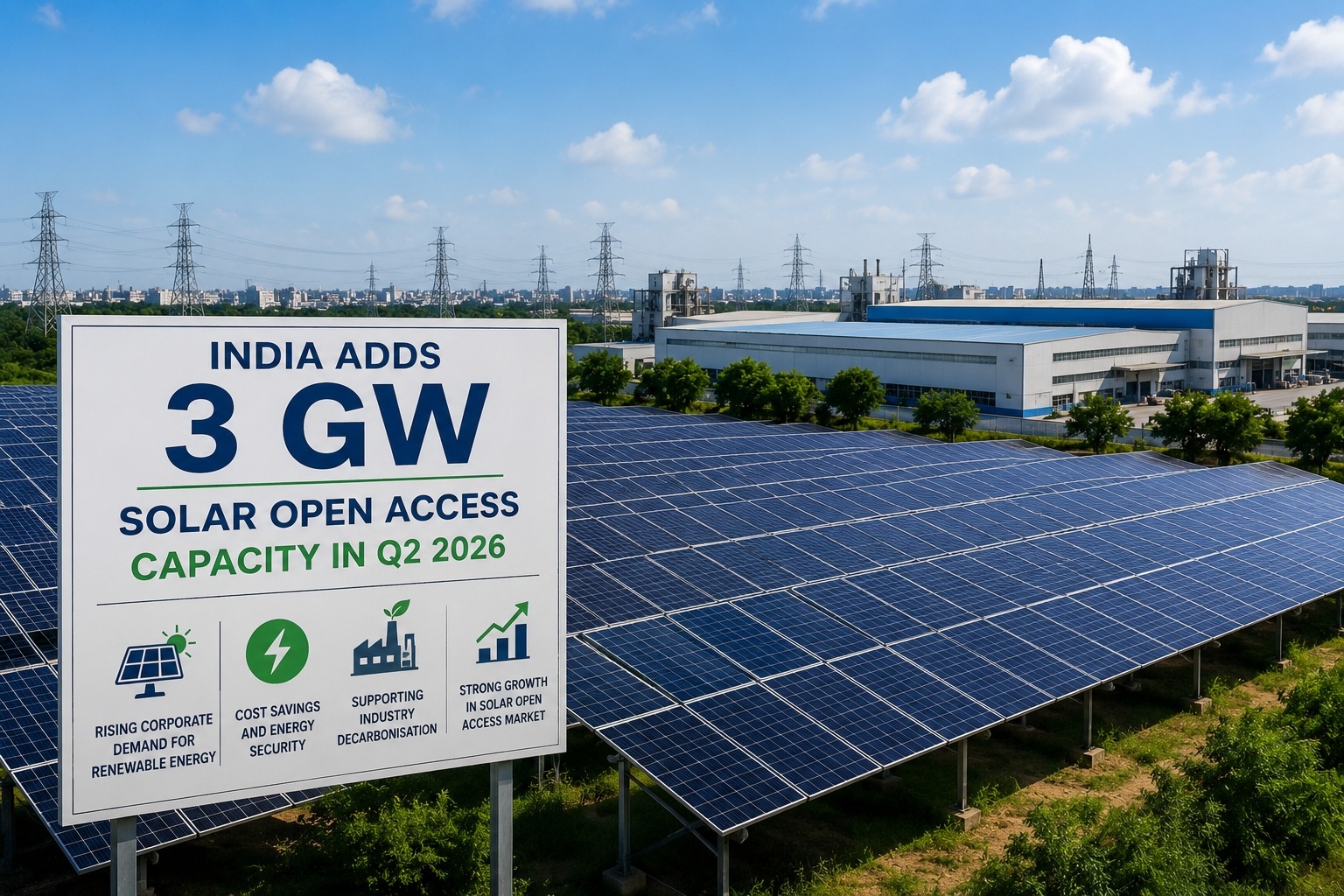
India added around 3 GW of solar open access capacity during the second quarter of 2026, marking a strong expansion in the country’s renewable energy market. The growth highlights increasing demand from commercial and industrial consumers for directly sourced renewable electricity.
Solar open access allows eligible businesses to purchase electricity directly from renewable energy generators instead of relying entirely on power supplied by distribution companies. The model is becoming increasingly attractive to companies looking to reduce electricity costs, secure long-term power supplies and meet their sustainability targets.
Corporate Demand Drives Growth
The strong quarterly addition reflects rising renewable energy demand from manufacturers, data centres, technology companies, commercial facilities and other energy-intensive businesses. Falling solar costs and corporate decarbonisation targets are encouraging more companies to enter long-term renewable power agreements.
Open access projects also provide opportunities for solar developers to build projects based on the requirements of specific commercial and industrial customers. This is helping expand private investment in India’s renewable energy sector.
Economic and Environmental Benefits
For businesses with high electricity consumption, solar open access can provide more predictable energy costs while reducing dependence on conventional power sources. Renewable electricity can also help companies lower emissions associated with purchased electricity and meet their environmental commitments.
The growth in the segment is expected to benefit solar developers, investors, equipment manufacturers and engineering companies by creating additional demand for solar modules, inverters, transmission equipment and related infrastructure.
Grid Infrastructure Remains Important
Continued growth in solar open access will depend on stable regulations, reliable transmission infrastructure and efficient grid connectivity. Open access charges, approval procedures and state-level policies can significantly affect project economics.
As more businesses shift towards renewable electricity, demand for energy storage, forecasting systems and advanced power-management technologies is also expected to increase.
The addition of 3 GW in a single quarter highlights the growing role of commercial and industrial consumers in India’s renewable energy transition. If this momentum continues, solar open access could become an increasingly important source of private investment, clean power generation and corporate decarbonisation in India.