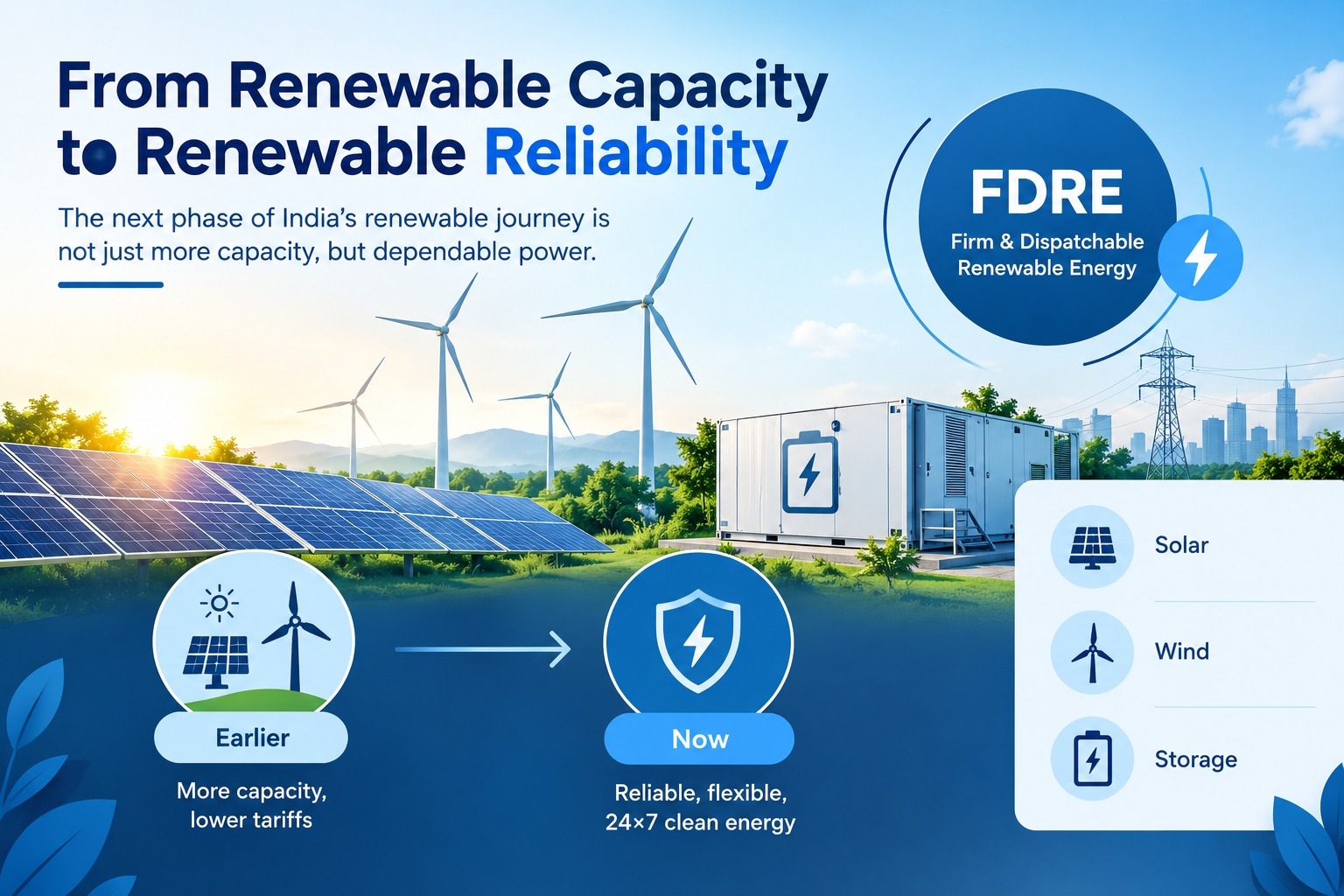
For much of the past decade, India’s renewable-energy sector focused on adding capacity at increasingly competitive tariffs. Solar and wind projects were developed primarily around how much electricity they could generate, while the grid and distribution companies managed the variability.
That approach is now changing. Buyers are increasingly looking beyond installed capacity and asking a more important question: how much renewable power can be guaranteed, and when can it be delivered? This is driving the growth of Firm and Dispatchable Renewable Energy (FDRE) projects.
What FDRE Means for Developers
FDRE contracts focus on a guaranteed electricity supply profile, rather than simply buying generation from a renewable plant. Depending on the contract, developers may need to meet a specified demand-fulfilment ratio, supply power during defined peak hours, or provide renewable electricity around the clock.
Any shortfall can result in penalties, while surplus electricity may need to be stored or sold through the market.
Solar, Wind and Storage Work Together
FDRE changes the way renewable projects are designed. A contracted 100 MW of firm renewable capacity may require significantly more installed solar and wind capacity, along with battery storage.
Solar generation can provide excess daytime electricity to charge the batteries, while wind generation can improve supply during nighttime and periods of lower solar output. Batteries then help deliver electricity during the specific hours required by the contract.
As a result, developers must consider solar and wind resource complementarity, available land, storage requirements and grid connectivity from the beginning of project planning.
Energy Modelling Becomes More Important
Traditional renewable projects often rely heavily on annual energy-yield estimates. FDRE projects require much more detailed modelling.
Developers need to analyse hourly generation, weather variations, battery charging and discharging, expected shortfalls and potential penalty costs throughout the year.
The objective is to identify the right combination of solar, wind and storage that can meet the contracted supply requirement while keeping the overall project cost competitive.
O&M Moves Beyond Routine Maintenance
FDRE also changes how renewable plants are operated. Instead of simply maximising generation, operators must ensure that electricity is available when the contract requires it.
This involves forecasting renewable generation, managing battery charge levels, responding to changing weather conditions and handling surplus electricity.
As a result, developers may need stronger energy-management and operations capabilities, rather than relying only on conventional EPC and maintenance services.
What FDRE Means for India’s Renewable Industry
FDRE could expand the role of renewable energy in applications where variable solar or wind power alone may not be sufficient.
For industrial and commercial consumers, firm renewable power can provide a pathway toward more predictable green electricity. Similar models could increasingly appear in central tenders, state DISCOM procurement and open-access C&I projects.
India spent the past decade learning how to build renewable capacity at lower costs. The next phase will focus on making that renewable power more reliable and dependable. FDRE is an important part of that transition.