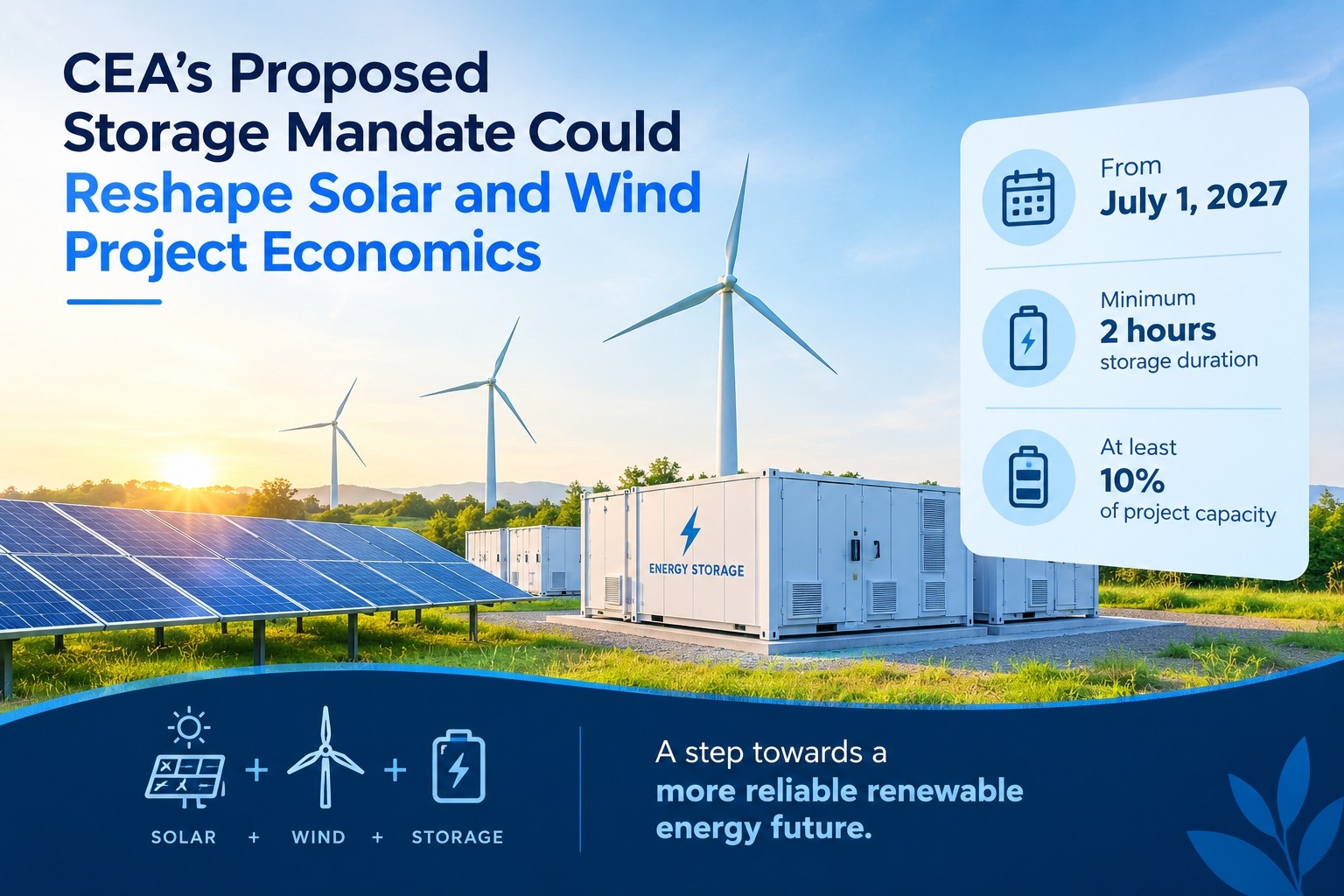
The Central Electricity Authority (CEA) has proposed mandatory co-located energy storage systems (ESS) for new ground-mounted solar and onshore wind projects in India. The proposal could significantly influence how renewable-energy projects are designed, financed and operated.
Under the draft regulations, projects commissioned from July 1, 2027 would need to install energy storage with a minimum discharge duration of two hours. The storage capacity would have to equal at least 10% of the project’s installed capacity.
For example, a 100 MW solar project would need at least 10 MW of storage capacity with two hours of discharge capability, equivalent to 20 MWh.
Storage Requirement to Increase From 2029
The proposed requirement would become more stringent for projects commissioned from July 1, 2029, through June 30, 2031.
During this period, the minimum storage capacity would remain at 10% of the project’s installed capacity, but the required discharge duration would increase to four hours. A 100 MW project would therefore require at least 10 MW/40 MWh of storage.
Impact on Solar Project Economics
The proposed mandate could increase upfront project costs because developers would need to plan for both renewable generation and storage.
It could also influence project design, financing, land requirements, equipment selection and operational strategies. Developers may increasingly need to consider solar generation and storage as an integrated system rather than separate assets.
Grid-Forming Technology Also Proposed
Alongside the storage requirement, the draft regulations propose grid-forming capabilities for renewable projects, including requirements for a portion of inverters and battery energy storage systems.
The objective is to improve the ability of renewable projects to support grid stability as India’s share of solar and wind generation continues to increase.
What It Means for India’s Solar Sector
If implemented, the proposed rules could mark a significant shift in India’s renewable-energy project development by making energy storage an increasingly important part of new solar and wind projects.
The proposal is currently a draft, and stakeholders have been invited to submit comments and objections before the rules are finalised.