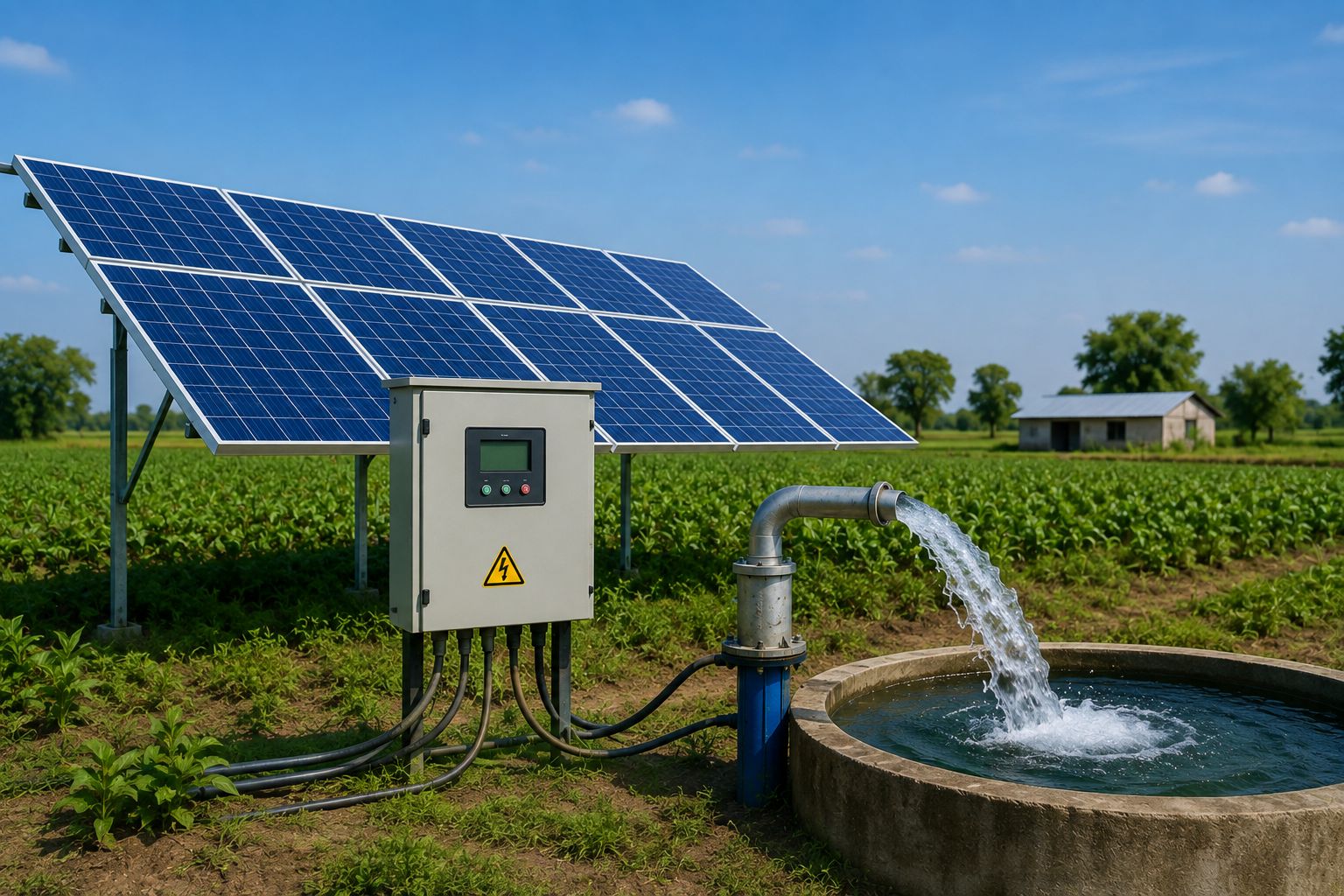
The Ministry of New and Renewable Energy (MNRE) has released draft revised specifications for solar pump controllers and invited stakeholders to submit feedback by August 28, 2026. The proposed standards have been developed by the National Institute of Solar Energy (NISE) to improve the efficiency, reliability, and overall utilization of solar-powered agricultural pumping systems.
The proposed changes aim to address a key challenge with solar water pumps: they are primarily used during irrigation seasons and often remain unused for long periods. To improve asset utilization, MNRE has proposed multi-functional controllers that can operate agricultural machinery and other electrical equipment in addition to water pumps.
The revised controllers would support off-grid, battery-based off-grid, and hybrid grid-connected systems. Multi-functional off-grid systems could offer up to four independent outputs, allowing them to power agricultural machinery, farm equipment, and household appliances.
The draft also proposes DC input voltages of up to 1,000 V, allowing controllers to work with newer solar modules and different PV configurations. Advanced Maximum Power Point Tracking (MPPT) technology would be required to maximize energy generation under changing operating conditions.
Efficiency requirements have also been strengthened. Controllers below 5 HP would need a minimum static power conversion efficiency of 93%, while systems rated at 5 HP and above would require 94%. Static MPPT efficiency would need to reach at least 98%, with dynamic MPPT efficiency maintained at 97% or higher. Systems of 10 kVA and above would also require multi-channel MPPT to reduce power losses caused by module mismatch.
For equipment such as chaff cutters and flour mills, the proposed standards include a 150% torque overload capability for up to 30 seconds. Additional safety requirements include IP65 protection, 6 kV surge protection, thermal and electrical safeguards, harmonic control, and automatic anti-islanding protection.
For grid-connected systems, the controller would need to disconnect from the grid within two seconds of a power outage. The draft also proposes integrated remote monitoring using GSM/GPRS connectivity and geo-tagging.
The monitoring system would provide information on solar generation, water output, operating hours, grid conditions, and faults such as dry-run events.
Overall, MNRE’s proposed standards are aimed at making solar pump systems more efficient, safer, remotely manageable, and useful beyond seasonal irrigation, while improving the long-term value of solar-powered agricultural infrastructure.