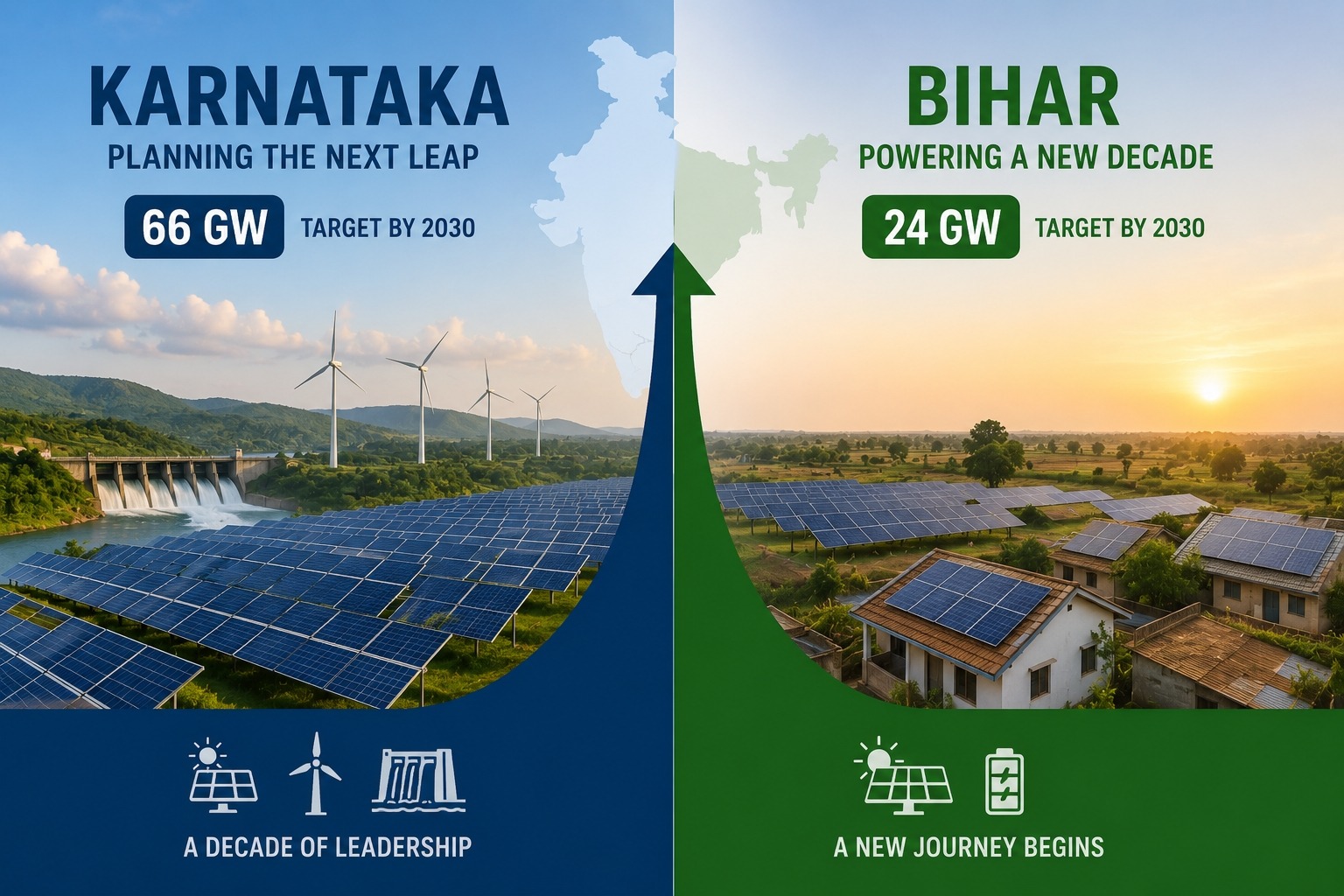
Karnataka has spent the past decade building a strong lead in renewable energy, while Bihar is only now beginning a large-scale clean-energy expansion. The gap between the two states remains significant, but Bihar’s new investment plans could mark a major shift in its renewable-energy trajectory.
Bihar has committed around ₹1.38 lakh crore toward its power sector and is targeting 24 GW of renewable-energy capacity along with 6 GWh of energy storage by 2030. At the same time, Karnataka is preparing to expand its overall installed power capacity to around 66 GW.
Karnataka’s Decade of Renewable Growth
In 2016, Karnataka had around 5,673 MW of renewable-energy capacity, compared with just 194 MW in Bihar. Over the following decade, Karnataka expanded its renewable base to approximately 27,442 MW, while Bihar reached around 709 MW.
This represents growth of roughly 384% for Karnataka and 266% for Bihar between 2016 and 2026. However, the difference in absolute capacity remains substantial, with Karnataka now having nearly 39 times Bihar’s renewable capacity.
Karnataka’s growth has been supported by large-scale solar development, hydroelectric capacity and major projects such as the 2,000 MW-plus Pavagada Solar Park, which helped establish the state as one of India’s leading renewable-energy markets.
Bihar’s Renewable-Energy Push
Bihar is now attempting to rapidly expand its renewable-energy infrastructure. Its 24 GW renewable-energy and 6 GWh storage target for 2030 would require a significant increase from its current base of less than 1 GW.
The state has also announced a ₹1,512 crore first-phase rooftop solar programme covering 2.5 lakh Kutir Jyoti beneficiary households. This forms part of a broader plan to bring 25 lakh households under the PM Surya Ghar Muft Bijli Yojana by November 2027.
Utility-scale solar and battery storage are also beginning to gain momentum in Bihar. The state has seen projects such as SJVN’s 75 MW solar project in Jamui, along with battery-storage procurement and earlier plans combining solar generation with BESS.
These developments indicate that Bihar is beginning to build a broader renewable-energy ecosystem involving rooftop solar, utility-scale projects and energy storage.
Karnataka Looks Toward Its Next Phase
While Bihar is accelerating its renewable-energy efforts, Karnataka is preparing for another phase of expansion.
The state is working on a roadmap to increase its overall installed power capacity from more than 39 GW to around 66 GW by 2030, with renewable energy expected to remain an important part of this growth.
Its Karnataka Renewable Energy Policy 2022–2027 targets 10 GW of additional renewable capacity and at least 1 GW of rooftop solar capacity during the policy period.
The state’s focus is also increasingly moving toward decentralised and distributed energy, alongside its established large-scale solar and hydroelectric capacity.
Two States, Two Different Renewable Journeys
Karnataka and Bihar represent two different stages of India’s renewable-energy transition.
Karnataka is moving from an established renewable-energy base toward its next phase of expansion, while Bihar is attempting to rapidly build the capacity it largely lacked during the previous decade.
If Bihar can translate its ambitious targets into actual projects, the state could become an important emerging market for solar generation, rooftop systems and battery storage in eastern India.
Together with renewable-energy plans emerging across West Bengal, Assam and Odisha, Bihar’s push could also contribute to the development of a stronger renewable-energy market in eastern India—creating new opportunities for India’s solar and energy-storage industry.