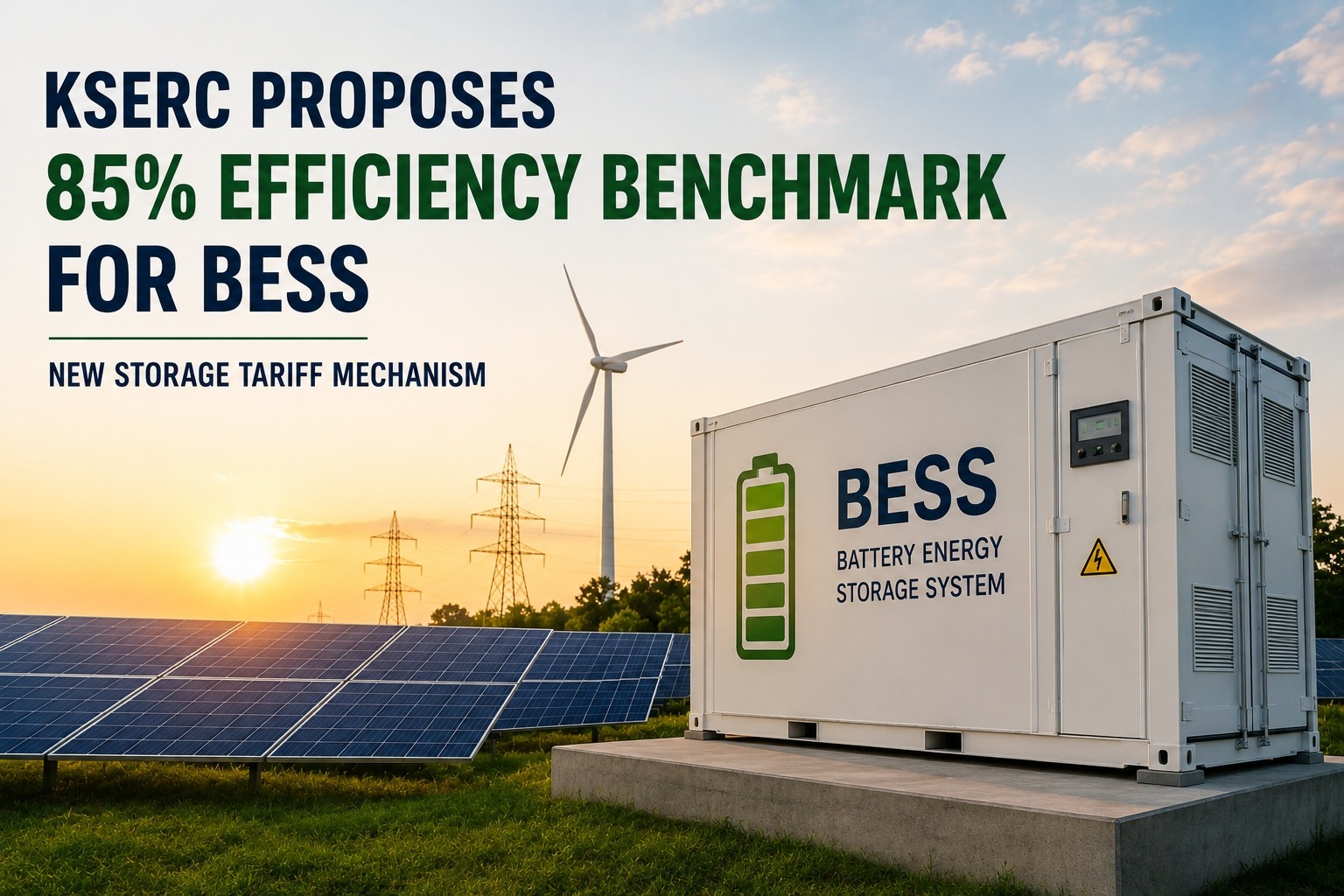
The Kerala State Electricity Regulatory Commission (KSERC) has proposed an 85% normative cycle-efficiency benchmark for Battery Energy Storage Systems (BESS) as part of its draft Multi Year Tariff (MYT) Regulations, 2026. The proposed framework aims to bring battery and other energy storage systems into Kerala’s regulated electricity market.
The draft regulations cover the 2027–32 control period and introduce separate technical and financial parameters for BESS, pumped storage projects (PSPs) and other energy storage systems. It also proposes recognising Energy Storage System Developers (ESSDs) as a new category of regulated entities.
85% Efficiency Benchmark for BESS
Under the proposed framework, BESS tariffs would include capacity charges along with performance-based incentives.
KSERC has proposed an 85% normative cycle efficiency for BESS. Storage operators achieving efficiency above this benchmark could receive an incentive of ₹0.20 per kWh for energy scheduled and supplied to beneficiaries beyond the prescribed efficiency level.
If the energy discharged by a BESS during a month falls below 85% of the energy consumed for charging, the efficiency incentive would not be available for that month.
The mechanism is designed to encourage storage operators to reduce energy losses during the charging and discharging cycle.
Beneficiaries to Arrange Charging Power
Under the proposal, BESS beneficiaries would be responsible for arranging the electricity required to charge the batteries, including applicable transmission and distribution losses up to the BESS busbar.
In return, beneficiaries would receive peak-hour energy equivalent to 85% of the energy used for charging. The BESS would be required to supply this energy during peak periods when requested.
For pumped storage projects, KSERC has proposed a lower 75% normative efficiency benchmark, with a similar ₹0.20/kWh incentive for energy supplied above the prescribed threshold.
Grid-Forming Inverters Proposed for New BESS Projects
The draft also includes technical requirements for upcoming BESS installations. Relevant projects would be required to use grid-forming (GFM) inverters capable of operating reliably under different grid conditions, including weak-grid situations.
The proposed systems would also need to provide rapid frequency and voltage support, strengthening the ability of storage projects to support grid stability.
Energy Storage to Support Peak-Hour Demand
KSERC’s proposed framework gives energy storage a specific role in peak-hour electricity supply. Distribution licensees could introduce tariffs for peak-hour support from energy storage systems, while storage could also participate in demand-response programmes.
The proposal also allows community and collective energy storage, including large-scale BESS associated with renewable energy projects. Consumers and prosumers could establish such systems under mutually agreed arrangements covering storage capacity, charging and discharging schedules, and cost and benefit sharing.
Where storage capacity is procured through competitive bidding under the Central Government’s Section 63 guidelines, KSERC proposes adopting the competitively discovered tariff through the prescribed regulatory process.
Broader Changes to Kerala’s Electricity Tariff System
The proposed storage framework forms part of a wider revision of Kerala’s electricity tariff structure. The draft also includes provisions related to:
- Demand-based fixed charges
- Time of Day/Time of Use tariffs
- kVAh-based billing
- Demand-response programmes
- Green tariff options
- Performance-linked incentives for electricity-sector businesses
Under the proposed ToD/ToU system, electricity could be priced lower during periods of high solar generation or lower demand and higher during peak-demand periods.
The draft regulations are currently under stakeholder consultation, with KSERC inviting comments, suggestions and objections before the framework is finalised.