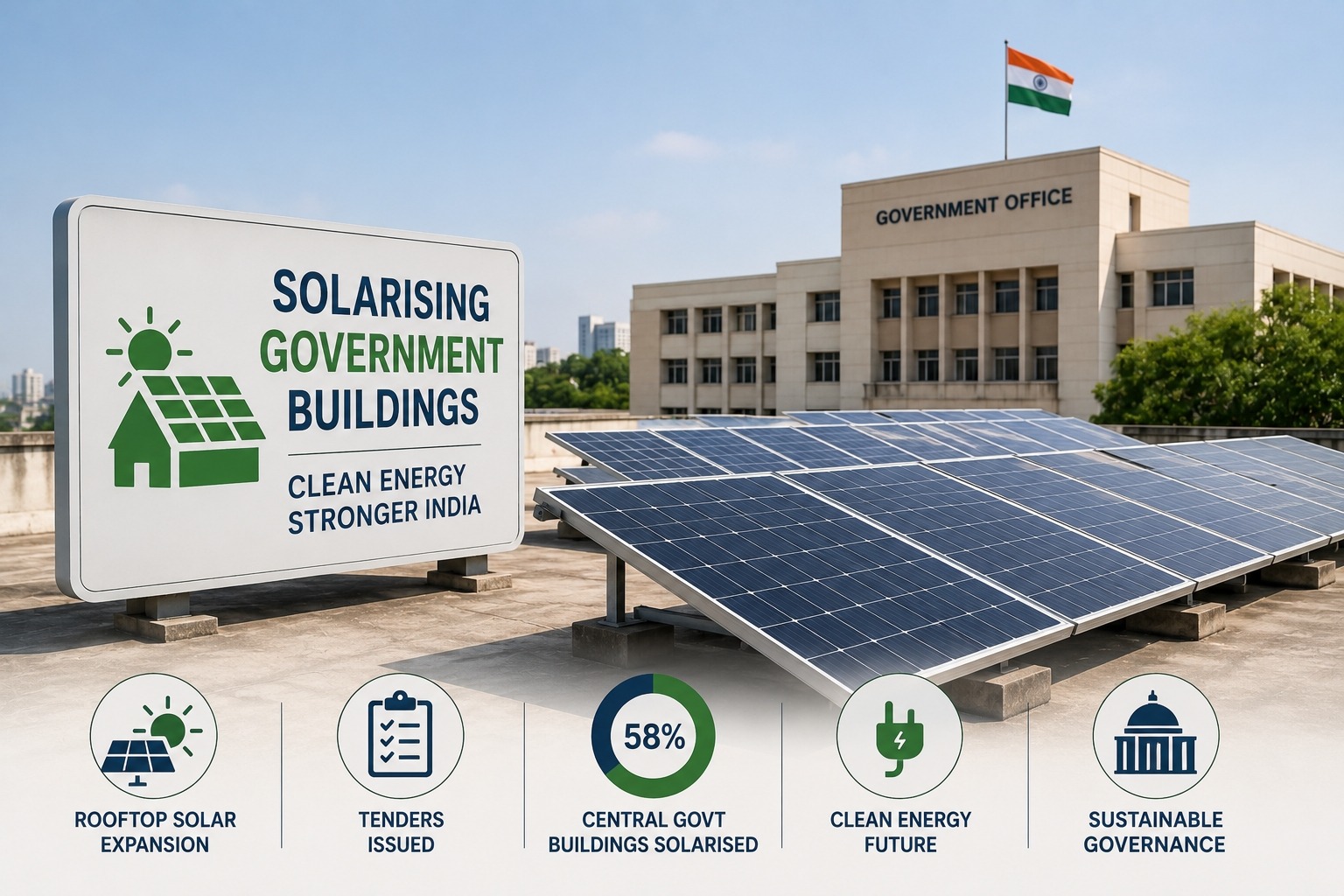
India is continuing to push rooftop solar adoption across government buildings, with states and central agencies issuing tenders throughout 2026. However, while new tenders are being announced regularly, limited public data on completed projects highlights a significant gap between planned solarisation and actual implementation.
States including Rajasthan, Uttar Pradesh, Uttarakhand, Maharashtra, Gujarat and Sikkim have issued tenders for rooftop solar installations at government facilities. Rajasthan’s RRECL floated a 33 MW tender in January, while REIL issued a 17.5 MW tender covering multiple states. NHPC also invited bids for 16.64 MW of rooftop solar projects for central government buildings.
More recently, Uttarakhand’s UREDA issued a 6.5 MW tender, while Uttar Pradesh’s UPNEDA invited bids for 11 MW of rooftop solar projects at government buildings. Most of these projects follow similar structures, including RESCO models, competitive bidding, long-term power purchase agreements and defined commissioning timelines.
Central Government Reports 24,376 Buildings Solarised
According to a Lok Sabha reply dated August 5, 2026, the Ministry of New and Renewable Energy (MNRE) received action plans for solarising 41,972 Central Government buildings. Of these, 24,376 buildings, around 58%, have been solarised, representing approximately 854 MW of installed rooftop capacity.
Across states and Union Territories, governments reported 81,754 government buildings with rooftop solar installations, representing approximately 1,447 MW of capacity. However, MNRE has not provided the total number of eligible government buildings at the state level, making it difficult to determine the overall completion rate.
MNRE has also stated that Central Financial Assistance (CFA) is not available for rooftop solar installations on government buildings, as such projects are considered financially viable without central subsidies.
Karnataka Highlights the Implementation Gap
Karnataka provides a clear example of the challenges involved. The state Energy Department estimates that nearly 59,000 government buildings could support around 698.2 MW of rooftop solar capacity.
However, as of August 2026, only 2,624 buildings had been fitted with rooftop solar systems, representing less than 5% of the identified buildings. The installed capacity stood at approximately 33.68 MW, also below 5% of the estimated technical potential.
State officials have attributed the slow progress mainly to funding constraints and the absence of subsidy support for institutional buildings.
States Continue to Expand Solarisation Efforts
Several states, including Gujarat, Rajasthan, Maharashtra and Tamil Nadu, have been identified by MNRE as performing well in government-building solarisation. Chandigarh and Daman & Diu have also previously reported complete saturation of their government-building targets.
However, publicly available data does not always provide a clear comparison between the number of eligible buildings and the number already solarised. This makes it difficult to accurately measure progress across states.
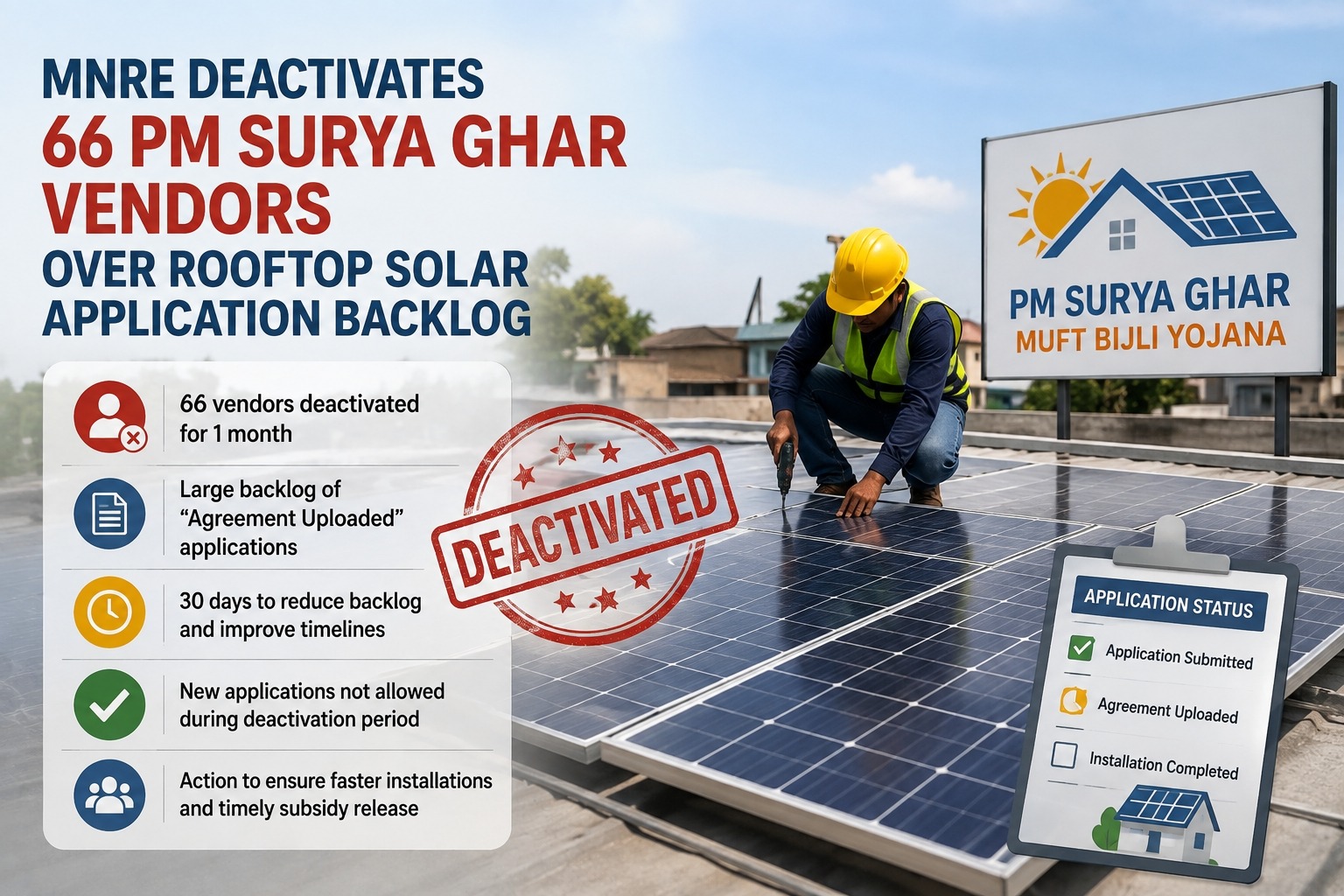
Madhya Pradesh also illustrates the difference between targets and implementation. In 2025, the state government announced plans to install rooftop solar systems on all government buildings by the end of the year. However, a corresponding completion figure has not been publicly announced. The state’s recently reported 566 MW of rooftop solar capacity relates to residential installations under the PM Surya Ghar scheme and does not represent government buildings.
Financing, DISCOMs and Execution Remain Key Challenges
Three major issues continue to affect government-building solarisation.
First, financing remains a challenge. Although RESCO models can reduce upfront investment, government institutions still need to manage long-term payments and budget approvals.
Second, DISCOM integration, net metering and billing arrangements can delay commissioning even after rooftop systems have been installed. Proper coordination between project developers, government departments and electricity distribution companies is therefore essential.
Third, delays in public-sector renewable energy projects are not limited to rooftop solar. Broader audit findings have also highlighted delays in renewable capacity development and execution across government and public-sector entities.
Tenders Are Growing, But Completion Data Is Crucial
The continued flow of tenders indicates that government-building solarisation remains an active part of India’s renewable energy strategy. RESCO structures, competitive tariffs and long-term PPAs provide a framework for developing rooftop solar without requiring large upfront investments from government institutions.
However, issuing tenders represents only the beginning of the process. Installation, commissioning, metering, grid integration and transparent reporting ultimately determine whether these projects deliver their intended benefits.
For tracking the programme’s real progress, completion figures against clearly defined targets are more useful than the number of tenders issued. Greater transparency in reporting installed capacity, eligible buildings and completed projects could provide a clearer picture of how effectively India is progressing toward solarising its government infrastructure.