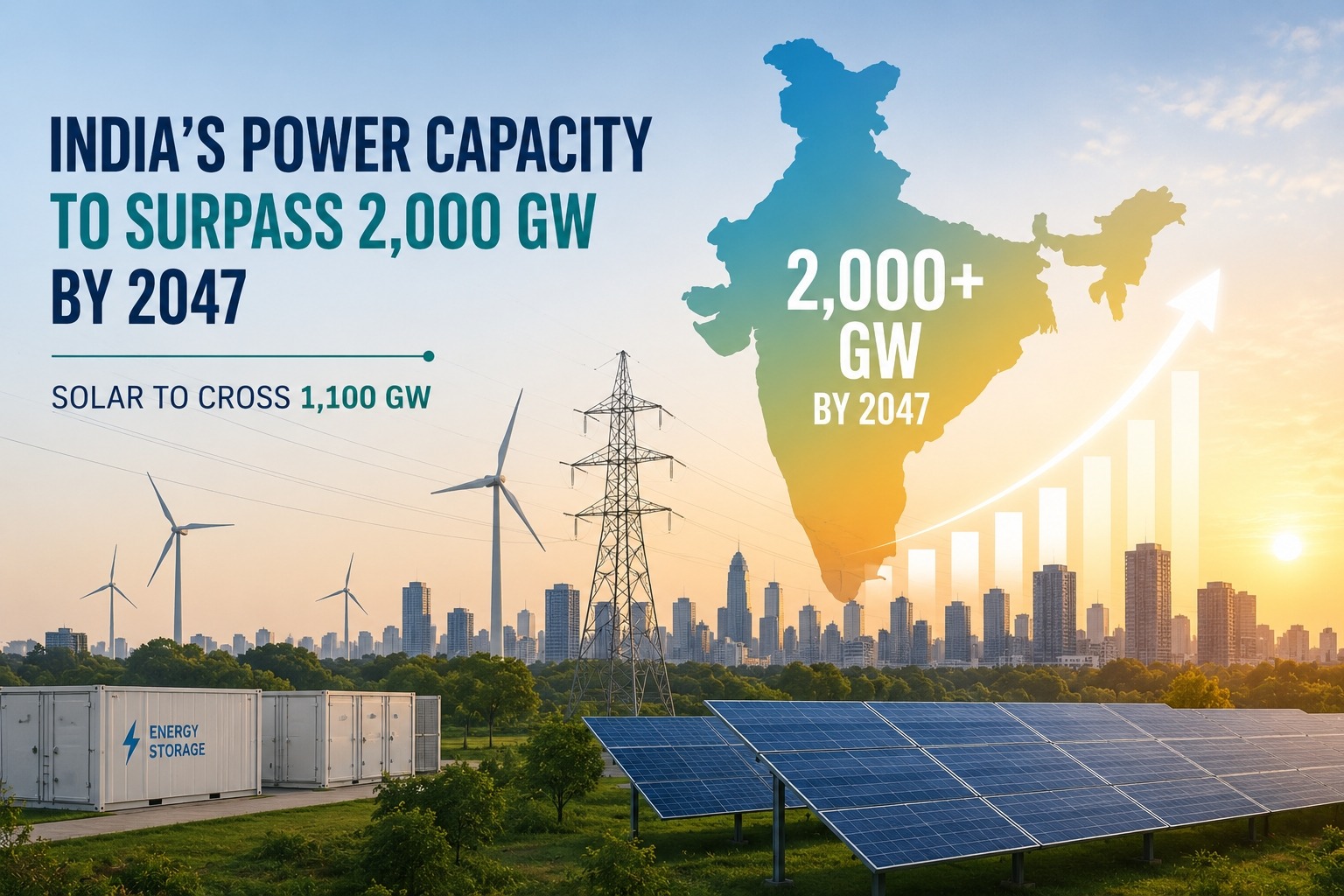
India’s solar power sector is expected to expand dramatically over the coming decades, with the country’s solar capacity projected to exceed 1,100 GW by 2047, according to the India’s Power & Energy Transformation Outlook released by the Energy & Climate Initiatives Society (ENCIS).
The report was unveiled in New Delhi during the inaugural session of Bharat Electricity, POWERGEN India & Indian Utility Week 2026. It highlights the scale of renewable-energy development required as India moves toward a cleaner and more diversified electricity system.
India currently has around 119 GW of installed solar capacity, according to the outlook. Increasing this figure to more than 1,100 GW by 2047 would require substantial investment in solar generation, transmission infrastructure, energy storage, manufacturing and grid-management technologies.
Solar Expansion to Drive Clean Energy Growth
The report highlights renewable energy as a major driver of India’s future power-sector expansion. Non-fossil sources currently account for approximately 53% of the country’s installed electricity capacity, which stands at around 540 GW.
The strong growth in electricity demand is expected to further increase the need for renewable generation. Peak power demand has already grown significantly over the past two decades and is projected to reach 366 GW by 2032, driven partly by emerging sectors such as data centres, electric mobility and green hydrogen.
Solar power is expected to play a central role in meeting this growing demand because of its expanding deployment across utility-scale projects, rooftop systems and other distributed-generation models.
Energy Storage Will Become Increasingly Important
Rapid solar deployment will also require major improvements in energy-storage infrastructure. The report estimates that India’s grid-scale energy storage capacity could need to increase nearly 40 times to around 200 GWh by 2030.
Storage will become particularly important as the share of variable renewable generation increases. Battery energy storage and other flexible technologies can help balance solar generation, manage fluctuations in electricity supply and support grid reliability.
Grid Infrastructure Needs to Keep Pace
The expected expansion of solar capacity will require corresponding investment in transmission and distribution infrastructure. Renewable-energy projects need adequate transmission capacity to move electricity from generation centres to areas with high demand.
The report also points to the growing role of smart meters and digital technologies in modernising India’s electricity distribution system. Nationwide smart-meter deployment is expected to reach around 250 million units by FY2028, potentially enabling more effective monitoring and management of electricity consumption.
Investment and Skilled Workforce
India’s power sector could require approximately $500 billion of investment by 2030 to support generation, transmission, distribution and clean-energy infrastructure.
The clean-energy transition is also expected to create significant demand for skilled professionals. More than one million workers may be required to support the sector’s digitalisation and renewable-energy expansion.
Solar to Remain Central to India’s Energy Transition
The ENCIS outlook indicates that India’s long-term energy transformation will depend heavily on accelerating renewable-energy deployment while maintaining grid stability.
With solar capacity projected to rise from around 119 GW today to more than 1,100 GW by 2047, solar power is likely to become one of the country’s most important sources of new electricity generation.
The projected growth highlights the need for continued investment in solar manufacturing, energy storage, transmission networks, smart-grid technology and skilled manpower. Together, these developments could help India build a larger and more resilient clean-energy system while progressing toward its long-term renewable-energy and energy-security objectives.